Story from the groundSingle-use plastics smothering corals in Jordan's Red Sea
Meet the Divers Pulling Plastic Off Aqaba's Reef
Below the surface of Jordan’s only stretch of coastline, a group of volunteer divers is fighting a war they did not start — one plastic bag at a time. The enemy, they have learned, comes from the land.
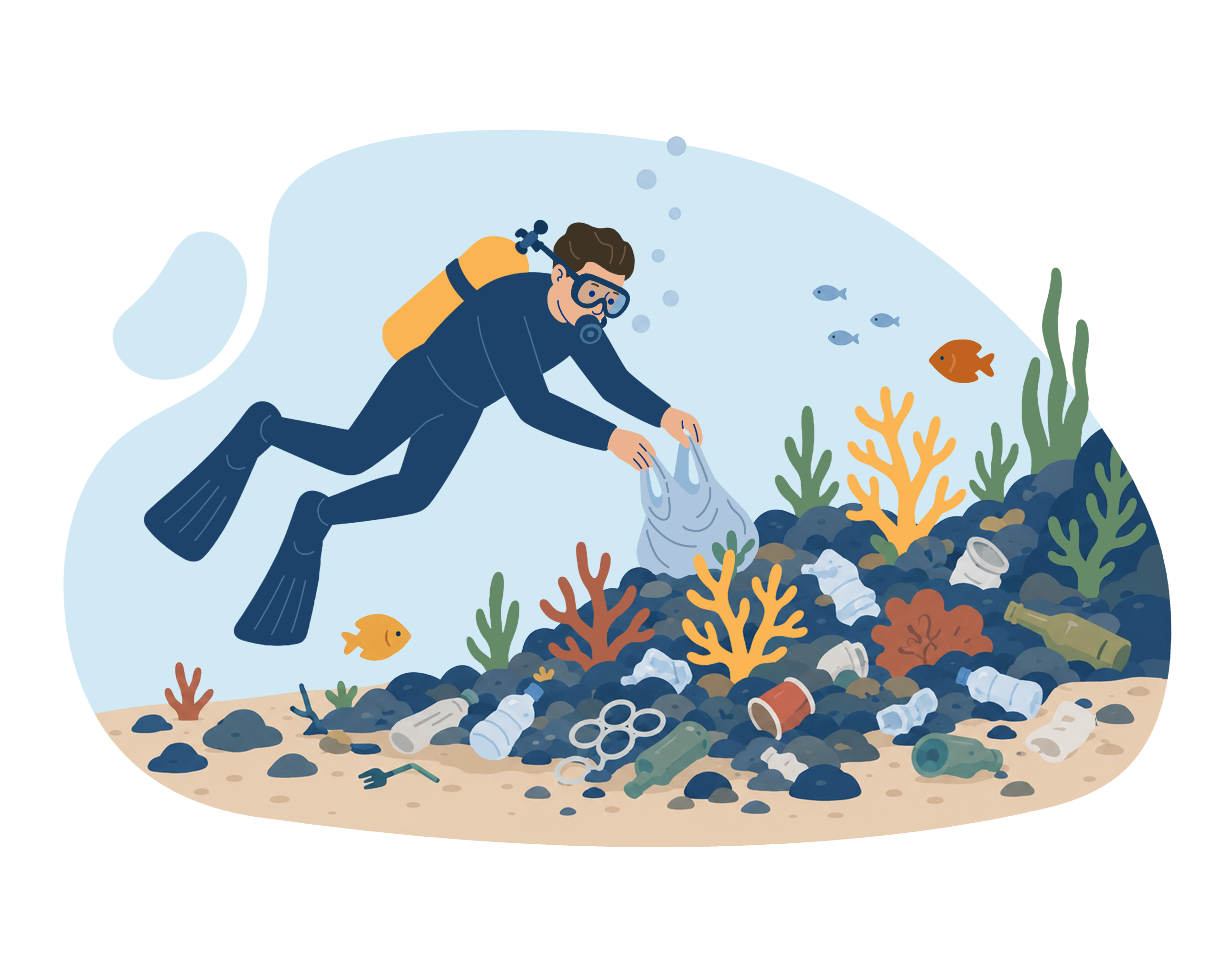

The Red Sea at Aqaba is, on a good day, a place of quiet astonishment. Sunlight filters through twenty metres of water and breaks into shafts above table corals and sea fans. Parrotfish move unhurried between formations that took centuries to build. Glass-bottom boats drift overhead, offering a window onto a world that has drawn tourists — and sustained local livelihoods — for generations.
But the view is fragile: when waste settles on the reef, it smothers coral and disturbs the animals that depend on it.
Alaa Hasassien grew up in Aqaba and has worked on the water for 18 years as a parasailing captain and water sports instructor. In 2019 he helped form the Blue Team, a group of 14 volunteer divers focused on removing debris from the seabed. “At first it was purely tourism-driven,” he says. “Tourists came, they saw rubbish in the sites, and we felt the need to clean it.” Over repeated dives, the team’s attention shifted from appearances to conservation. They learned techniques to remove debris without breaking fragile coral, and they began to track what they recovered.
Abed Khalifat, a Blue Team member and a diver since 2017, recalls the scale and of those first clean-ups: “One of our first dive we pulled out 55 plastic bags.” The team now records and sorts everything they remove to trace sources. They commonly find single-use plastic items — plastics manufactured to be used once, sometimes for only a few minutes, before being discarded — mainly cups, bags, and wrappers, often near or draped over coral formations.
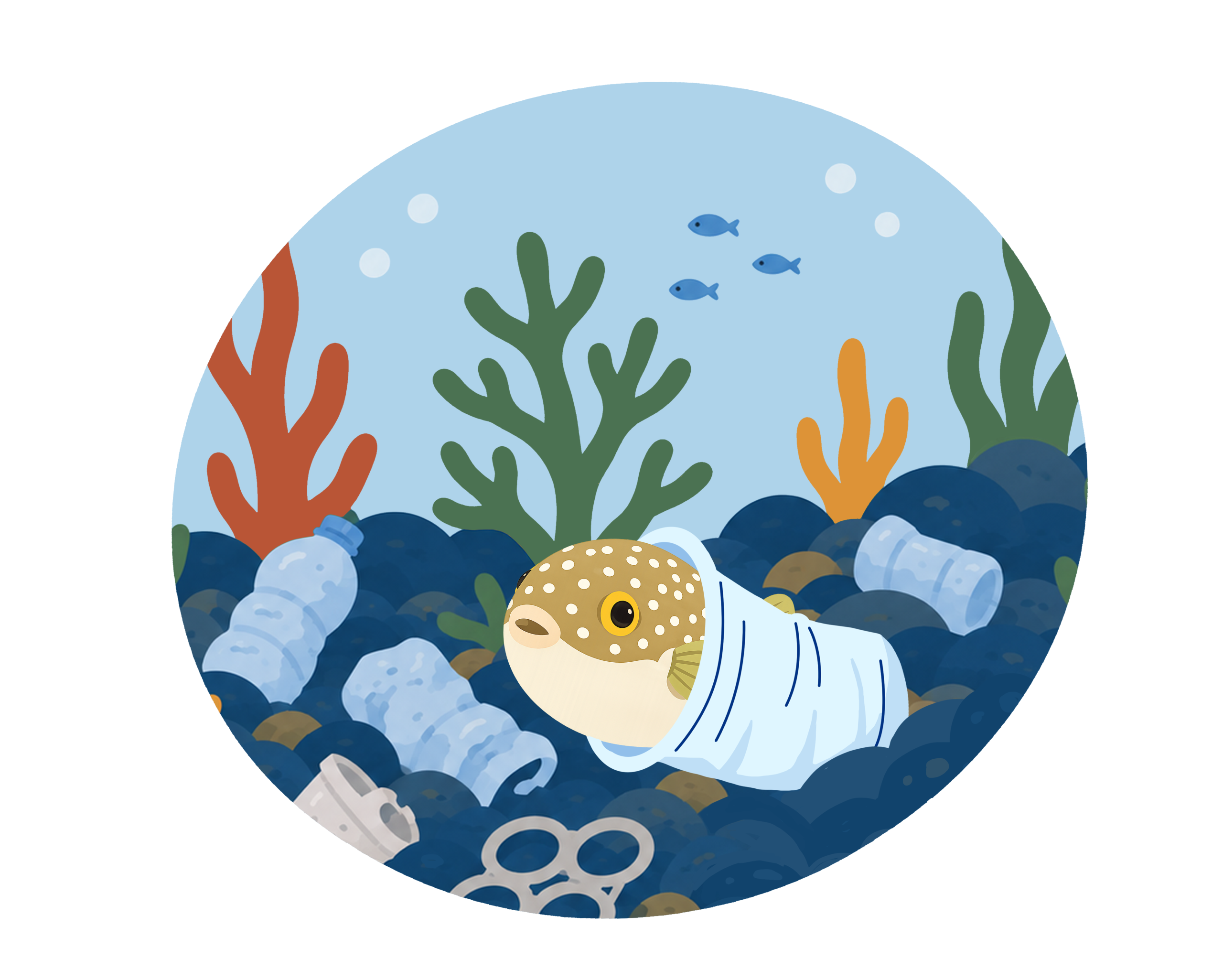
Once they found a pufferfish – “Nemo” as locals call it – nesting inside a plastic cup.
Their data-backed dives reveal a grim truth echoed by local authorities, a vast majority of the plastic they find in the sea originates on land, pushed to the shore by wind and floods.

People think that if they don’t throw plastic in the sea, it won’t end up there. But waste thrown anywhere can reach the water. [Abed Khalifat, Blue Team member and diver.]
The science bears out his concern. Corals grow slowly — roughly a centimeter a year for many species — and damage from smothering or abrasion can take decades to repair. Removing entangled plastic requires careful buoyancy control and steady hands: a single misjudged movement can break what took a generation to form. Blue Team members train specifically for those constraints, emphasising precise, low-impact technique during every clean-up dive.
500 plastic bags a year
The plastic that ends up on Aqaba’s seabed does not arrive from one place. The Gulf of Aqaba is bordered by four countries, and wind and currents carry debris from multiple directions. But the dominant finding of researchers is consistent with what the divers observe: most of it starts on land. In Jordan, the scale of what enters that cycle is considerable. The average person uses around 500 plastic bags every year, almost all of them once, then discarded. Of the total municipal waste the country generates, only 7 to 15 percent is currently recycled. The rest — the bags, the cups, the wrappers — goes to landfill, or somewhere less contained.
For many urban residents, the link between everyday plastic use and a distant reef has never felt direct. But a growing number of young Jordanians are making the connection.
“After seeing all this plastic accumulating, I started carrying my water flask everywhere and refilling it when needed. This decision was very practical honestly and I think I saved money doing so.” And I felt the micro plastics are not only hurting my health but the beautiful landscape around us.” Says Rasha Sameer, a schoolteacher in Amman.
After seeing all this plastic accumulating, I started carrying my water flask everywhere and refilling it when needed. This decision was very practical, and I think I saved money doing so. [Rasha Sameer, Amman schoolteacher.]
Back in Aqaba, the divers describe what a steady flow of plastic looks like up close. Beyond the physical damage to coral, single-use items alter the behaviour of marine life. Alaa and his colleagues describe fish nesting near or inside plastic objects, and animals trapped in bottles or cut containers. These are not isolated anecdotes; they are consistent with what the volunteers retrieve on every dive. The team’s conclusion is unequivocal: the most effective intervention is stopping single-use plastics from reaching the coast in the first place.
One of the most direct ways people can help protect the Red Sea is by reducing their use of single-use plastics — because much of what ends up here starts on land. [Alaa Hasassien, water sports instructor and Blue Team founding member.]
Plastic Travels by Wind and Floods
Nasser Zwaidah, manager of the Aqaba Marine Reserve under the Aqaba Special Economic Zone Authority (ASEZA), has matched grassroots urgency with institutional action. ASEZA now runs outreach in schools and universities, enforces fines for littering, and is working to phase alternatives into the local market – encouraging glass, cardboard, and paper over single-use plastics. “Plastic travels by wind and floods,” he says. “Plastic bags, in particular, can suffocate corals by blocking light and closing its pores.”
Clean-up campaigns in 2024 removed tens of tonnes of material, and ASEZA reports declining waste volumes in some monitored sites. But Zwaidah is candid about the limits of what clean-ups alone can achieve: demand for single-use items, he says, must fall.
Progress is real but partial. Enforcement, alternative products, public awareness and education, and continued monitoring are all part of the solution — and none of them works without the others. Single-use plastics remain standard in everything from neighbourhood corner shops to large supermarkets, cheap to produce and easy to distribute. While they may be used for a few minutes, they can remain in the environment for hundreds of years.
Alaa knows he cannot clean his way to a healthy reef. The work matters — the Blue Team’s dives protect coral that would otherwise be smothered — but it is, at best, damage limitation. What he asks of people is simpler than a dive certification: use fewer disposable items, bring a reusable container, secure your rubbish on a windy day. “One of the most direct ways people can help protect the Red Sea,” he says, “is by reducing their use of single-use plastics — because much of what ends up here starts on land.”
Beneath the glass-bottom boats, the reef is still there — the parrotfish, the sea fans, the slow patient coral. Whether the view it offers in ten years shows living colour or grey debris depends less on what happens underwater than on the choices made, daily, far from the shore.
Is your climate changing?
Take this quick quiz and see how climate change is unfolding where you live.